Biography
Charlotte Greig
1954-2014
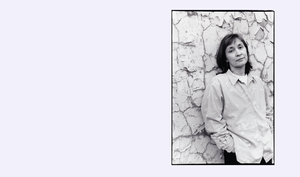
Charlotte Greig was born in Malta in 1954. Her father was a naval office and was stationed there at the time. Later his career would take the family to Gibraltar and Singapore before returning to England in the early sixties. They lived near her grandparents on Exmoor for a while. More than anywhere Exmoor was the place that felt like home to her, and it’s where her ashes are scattered. They moved to Suffolk for a time, where she attended Charsfield village school, as described in Ronald Blythe's book Akenfield, where she learned to sing folk songs. At the age of 10 she was sent to a convent boarding school, St Stephen's College, Broadstairs, Kent, which she came to love. While there she played the piano, acted, and swam competitively. After school, and a brief interlude with a very dodgy boyfriend in Switzerland which saw her pursued by Interpol, she studied philosophy at Sussex University during the 1970s, a period she used as the setting for her first novel A Girl's Guide to Modern European Philosophy. One year of the course was spent living in Aix-en-Provence, a time which inspired the song Free Fall, on her At Llangennith album.
After university she moved to London and drifted from job to job before the birth of her first son Henry and marriage to her first husband, the confusingly surnamed Andy Gregg, who she’d met at Sussex. The marriage didn’t last, though they remained on good terms. Charlotte found a job she liked at left-wing publishers Pluto Press and adjusted to life as a single mother.
It was at this time that she started , for the first time since childhood, to make space for her artistic side. She had always loved music but felt entirely out of place in the male-dominated prog-rock early 70s. Punk had passed her by, she much preferred soul and reggae. Hip hop, however, triggered something in her. She worked on the pinoeerign book, The Rap Attack, with Daid Topp and Toop encouraged her sto saart writing her own raps. She formed a feminist rap duo F-F-F-Female Force with her friend Sue T(hompson). Their early mixtapes were played by Tim Westwood on LBC, but the gulf between her life and that of the teenage kids she was mixing with started to yawn too wide. She tried an art rap project with Miquette Giraudy from Gong then; reaching for something she still couldn’t quite grasp.
Meanwhile she had met the writer John Williams, who would become her second husband, and she had begun a parallel career as a music writer. She wrote for the NME, City Limits and Arena amongst others. The great feminist publisher, Virago, commissioned her to write a history of girl groups in pop. Will You Still Love Me Tomorrow came out in 1989 and attracted rave reviews all round. Its particular strength was the number of original interviews which gave the lie to the former prevailing wisdom that girl groups were simply the puppets of male producers. This in turn led to her making a radio version of the book - a series of six one-hour documentaries for Radio One.
Inspired by this, she started writing out-and-out songs herself, beginning with one that came to her fully formed, an otherworldly incantation called Crows. Other early songs veered from country rock to baroque pop. She formed a band, variously called The Mountain Kings and Crow Country, featuring Spike Williams of Weekend on guitar, and the Young Marble Giants’ younger brother Drew Moxham on drums. Crow Country made one 7” single, Woman with a Black Name, produced by Steve Beresford. It coincided, however, with the birth of her second son Owen and she soon lost enthusiasm for the grind of playing live shows to frankly meagre audiences.
Instead, she started immersing herself in traditional music, inspired by listening to the likes of Anne Briggs and, particularly, Shirley Collins, She started attending the weekly folk song sessions held in the bar at Cecil Sharp House, the home of the English Folk Dance and Song Society.
She began playing live again; at first in an acoustic trio called Folk City Sisters with Jacqui Callis and Emma Peters. They played around London and the odd folk festival before heading off on their separate paths. Charlotte started to play solo for the first time, backing herself on Indian harmonium and dulcimer, plus an idiosyncratically programmed Dr Rhythm drum machine, and performing a mix of traditional and self-written songs.
This is the material that would appear on Night Visiting Songs, which she recorded in 1997 entirely solo, apart from the vocals of Jacqui and Emma on one track. It was released in 1998. There were some good reviews, notably from Stewart Lee in the Sunday Times.
Later in 1998 Charlotte and her family moved to Cardiff, where she would remain for the rest of her life. She soon met the multi-instrumentalist Julian Hayman and would collaborate with him on her next four albums: Down In The Valley (2000), At Llangennith (2001), Winter Woods (2003) and Quite Silent (2005). During this time Charlotte and Julian gigged around the UK with occasional visits abroad to Europe and, on one occasion, the US. Her most regular appearances were at Chapter Arts Centre in Cardiff, where she ran a monthly folk/country night called alt.Cardiff with John Williams. She also appeared at the first half dozen Green Man Festivals, at first in a duo with Julian Hayman and then in a trio with the addition of guitarist Edward James.
After Quite Silent , however she stopped writing songs for a while, turning her energies instead to prose She wrote a first novel, A Girl’s Guide to Modern European Philosophy and an unpublished memoir, A Childhood In Nineteen Songs. She also conceived a stage play, I Sing Of A Maiden, on the subject of unplanned pregnancy, featuring a mix of traditional songs performed by Charlotte and her trio, plus a dramatic monologue written by Rachel Trezise and performed by Carys Eleri. This was a popular success and ran for two short seasons at Chapter Arts Centre.
In 2013 she published her first crime novel, featuring a psychotherapist sleuth, The House on The Cliff, under her married name Charlotte Williams. A second novel in the series, Black Valley, was published in 2014.
Her musical carer continued alongside all this. She continued to play live with her trio. She made some recordings with the French singer/songwriter Johan Asherton, three of which appeared on the John Barleycorn Reborn compilation. In 2007, she co-curated and contributed to Migrating Bird, a tribute album to her particular inspiration, the late Lal Waterson, released on the Honest Jon’s label.
In 2008 she began collaborating with Anthony Reynolds, first appearing on his EP, Like The Sun Feeds From Flowers, and then on a series of songs inspired by the early cases of Sigmund Freud, whose work Charlotte had recently been reading. This evolved into a stage show and album, "Studies in Hysteria" credited to Doctor Freud's Cabaret. The album featured Charlotte accompanying a selection of guest vocalists – Euros Childs, Jon Langford etc – alongside contributions from herself and Anthony Reynolds. Sadly release of the album coincided with the cancer diagnosis that would ultimately lead her to take her own life in June 2014.